Countera

Free on Google Play

Money arithmetic, practised daily

Mental maths for the money you actually deal with.

Discounts, unit prices, which pack is the best value, splitting a bill and what you are still owed. The sums you meet in a shop, a restaurant or a conversation, practised until you can do them without reaching for your phone.

  • No account needed
  • Works offline
  • A real skill rating
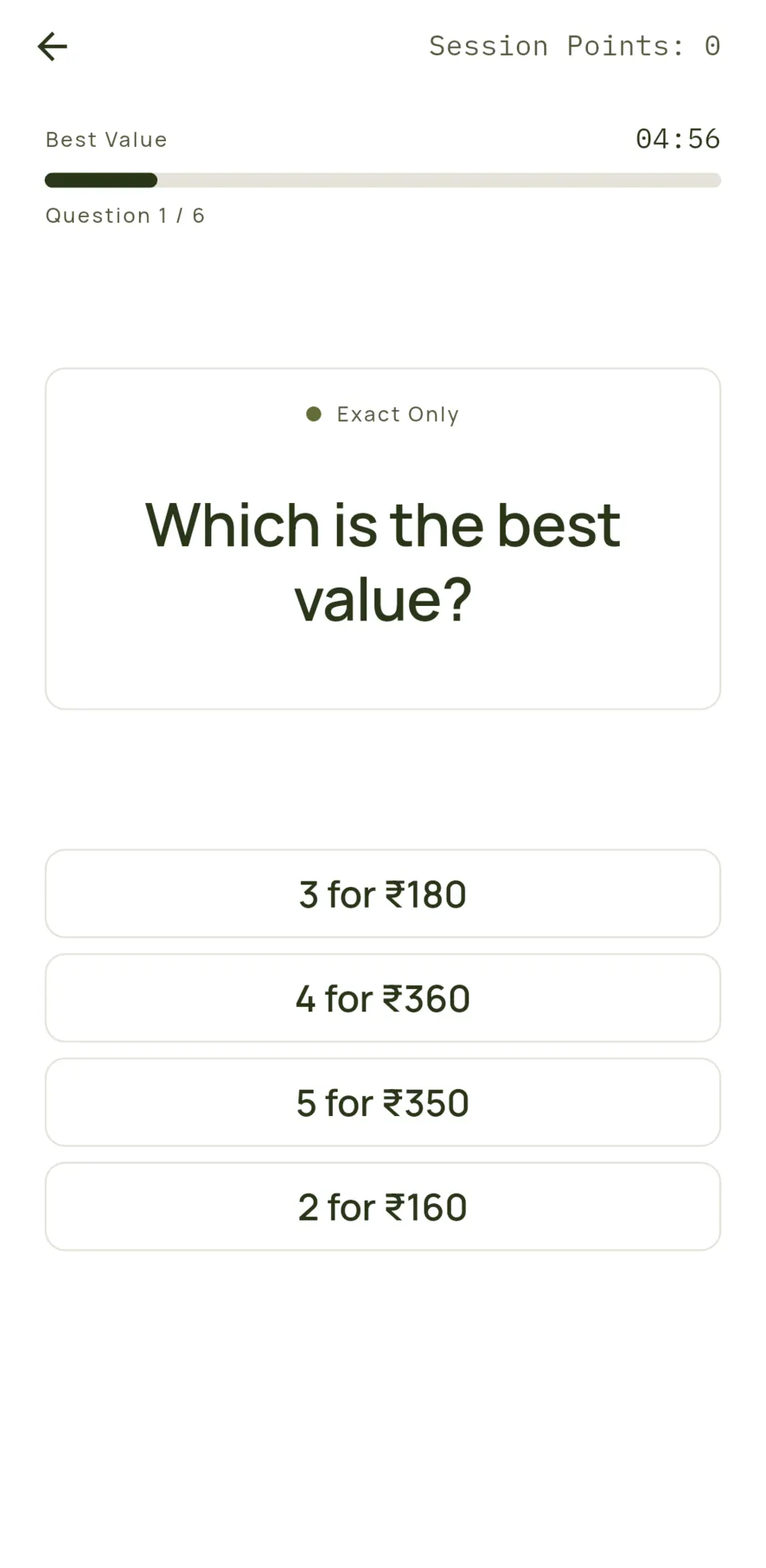
A Best Value question with four offers: 3 for ₹180, 4 for ₹360, 5 for ₹350 and 2 for ₹160
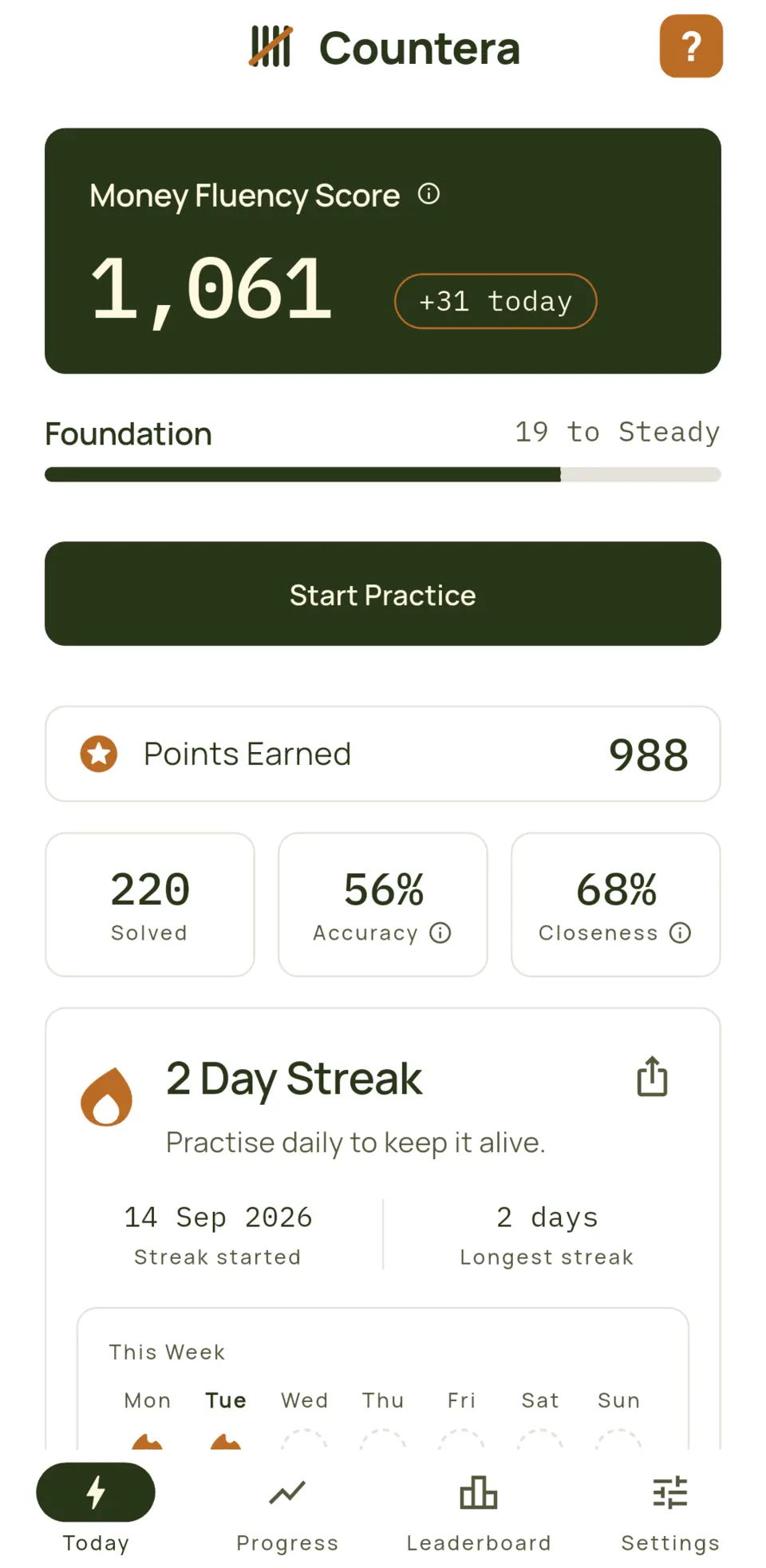
Countera's Today screen: Money Fluency Score 1,061, up 31 today, Foundation with 19 to Steady, and a 2 day streak

What Makes Countera Different

  • Free on AndroidThe whole app, every mode and every question, with or without an account.
  • No Internet Needed to PractisePractice works fully offline. Only the optional leaderboard needs a connection.
  • No Account NeededEverything works as a guest. Sign in only to join the leaderboard.
  • Practice for the Maths You Actually DoDiscounts, unit prices, best value, splitting a bill and what you are owed, practised as real money questions.
  • Practise the Way You Work on PaperPlain drills can be written in a column, and answers typed from the units up.
  • A Real Skill Rating, Not a Points TotalThe Money Fluency Score rises as you get harder questions right, and near answers count where estimating is the skill.
  • Shows You How When You MissEvery miss is worked through step by step on your own numbers, and the next session leans toward your weak spots.
  • A Daily Session Is Six QuestionsLonger sessions of 12, 25, 50 or 100 are one tap away.
  • Your Money, Your CurrencyRupees, dollars, pounds, euros or yen, with Indian grouping such as ₹1,24,500.
  • Private by DesignYour practice history is never uploaded. No advertising and no analytics.
  • Nothing Is LockedEvery mode is open from day one.
  • Streaks and Shields for Showing UpThey reward consistency and firsts, never grinding.

Try One Now

Four offers on a shelf. Which one costs least for each item?

This is a real Best Value question, the kind Countera asks. There is no keypad: the tap is your answer, and only the best offer counts. The biggest pack is not always the best, the best can be in any position, and the offers are never so close that picking is a coin toss.

Every Best Value question is division underneath, so each one moves your division rating.

Best ValueExact Only

Which is the best value?

Pick one, then check the working.

Show the Working
  1. ₹360 ÷ 4₹90 each
  2. ₹510 ÷ 6₹85 each, the best
  3. ₹880 ÷ 10₹88 each
  4. ₹1,068 ÷ 12₹89 each

Every Question Is About Real Money

Pick a mode and how many questions, and each one arrives as a sentence a person would say. Every mode feeds the same five ratings, and nothing is locked.

  1. Step 1Read a money questionA discount, a bill split five ways, four packs on a shelf.
  2. Step 2Work it out in your headType a whole number on the keypad, or tap an offer. No decimals, ever.
  3. Step 3Graded the way life gradesClose counts where estimating is the skill. Exact only where a near answer is no use.

Seven Money Modes

  • Money MixedEverything, drawn at random. If you are not sure, start here.
  • ShoppingDiscounts, the price before a discount, and tax.₹4,200 with 30% off. What do you pay? Close Counts
  • MarginBuying, selling, and the profit.
  • RatesUnit prices, and how many you can get.
  • CreditWhat is owed, paid, and still outstanding.Ravi owes you ₹720 and Priya ₹99. How much are you owed in total? Exact Only
  • SplittingBills, and cost per use.A ₹320 bill split 5 ways. What does each person pay? Exact Only
  • Best ValueThe cheapest offer per item.4 for ₹360, 6 for ₹510, 10 for ₹880 or 12 for ₹1,068. Which is the best value? Exact Only

Below the money modes, the Practice Room has plain sums with no money story: addition, subtraction, multiplication, division and percentages, one at a time or mixed.

A Session Fits in a Few Minutes

When the last question is answered, the result screen shows how the session went: how many answers were perfect, close and missed, and how far your rating moved.

6
Six questions by default. Or choose 12, 25, 50 or 100. It goes back to 6 next time, so one long session never becomes your daily one.
50s
Fifty seconds a question. Shared across the session, so 5 minutes for 6. A question still unanswered when the clock runs out costs you nothing.
3
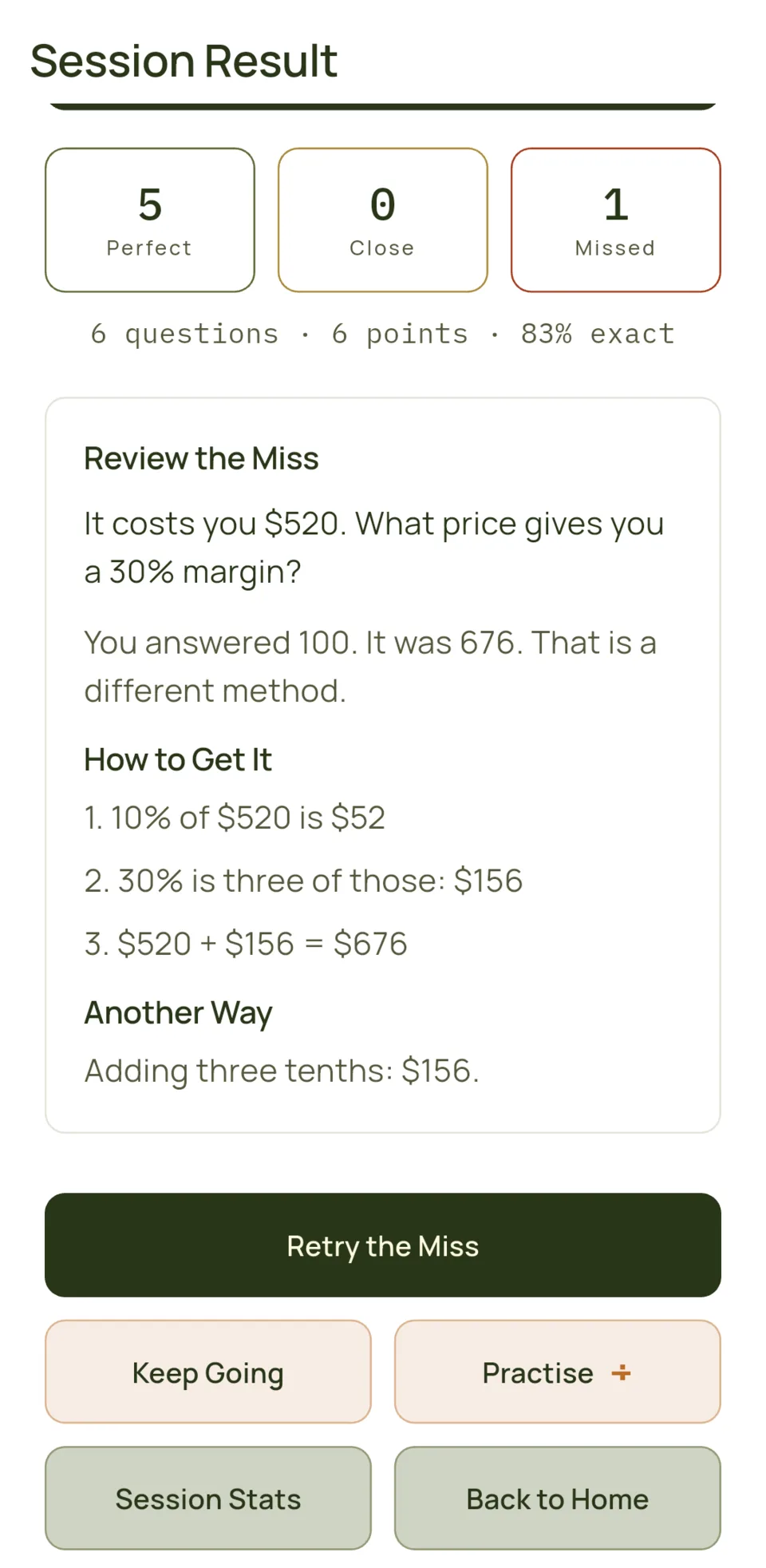
Every miss worked through. Miss a question and it is worked out on your own numbers, step by step, with a second method where there is one. Retry the Miss gives you 3 more of the kind you were furthest off on.
69
Type from the units up, if you like. With Right to Left entry each new digit goes in front, so typing 9 then 6 gives 69.
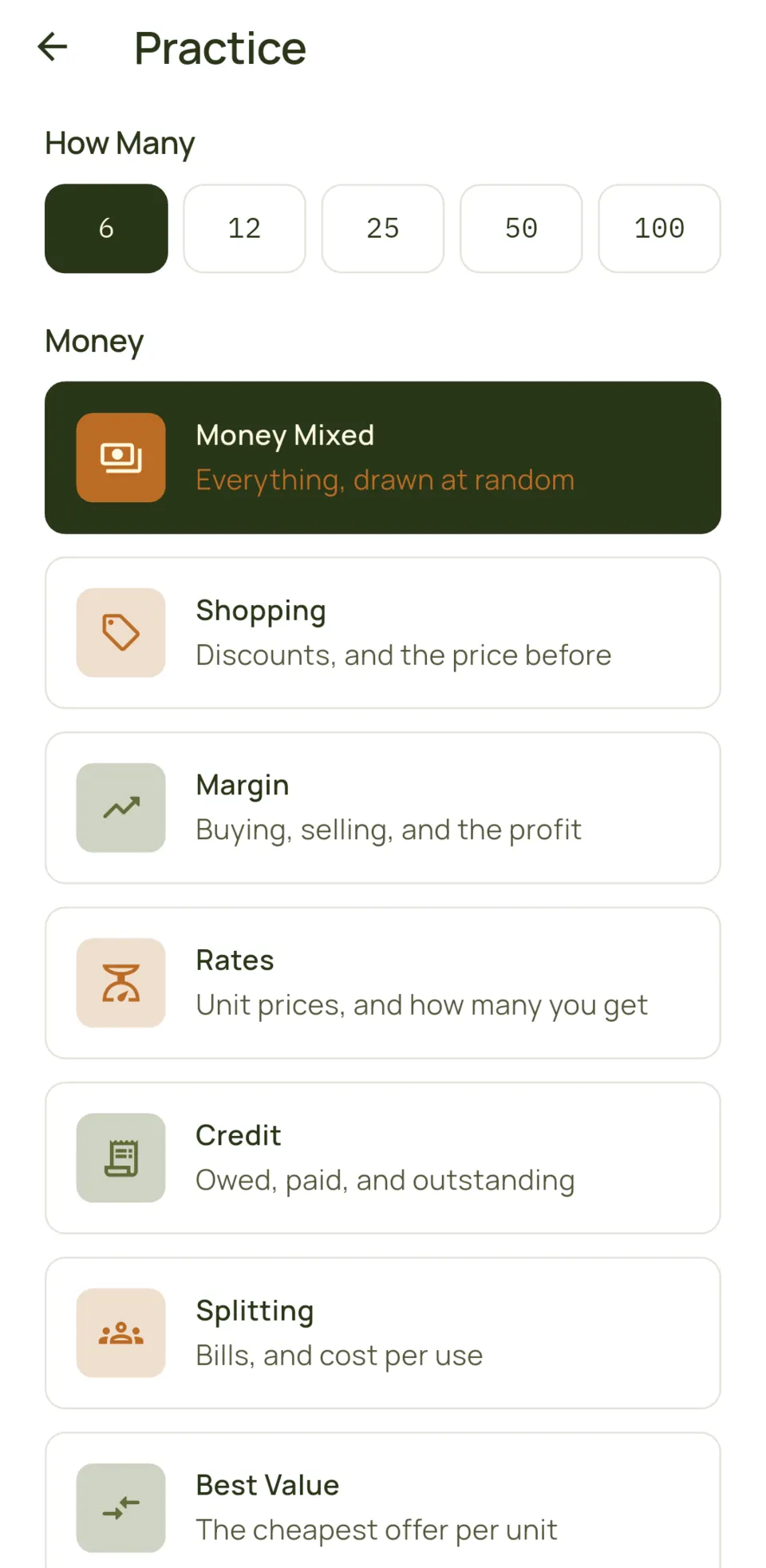
The Practice screen: How Many from 6 to 100, then the seven money modes from Money Mixed to Best Value
A Best Value question with four offers: 3 for ₹180, 4 for ₹360, 5 for ₹350 and 2 for ₹160
The Practice screen: How Many from 6 to 100, then the seven money modes from Money Mixed to Best ValueA Best Value question with four offers: 3 for ₹180, 4 for ₹360, 5 for ₹350 and 2 for ₹160Session Result: rating change +18, 5 perfect, 0 close, 1 missed, and the miss worked through: 10% of $520 is $52, 30% is three of those: $156, $520 + $156 = $676

Real screens, Pixel 10a

Practise the Way You Work It Out

Three preferences in Settings change how a plain drill is written, which end a typed digit goes on, and which way up the keypad runs.

Answer Entry

Answers Typed from the Units Up

24×496

Working the column gives the 6 first, then the 9.

Left to Right69Graded wrong
Right to Left96Right

Working a sum down a column gives you the units first: 24 × 4 gives the 6 before the 9. Typed left to right, those digits make 69, and a sum you did correctly is graded wrong. With Right to Left, each new digit goes in front, so 6 then 9 makes 96.

Settings, Answer Entry, or the direction button above the keypad during a question

Drill Layout

Drills Written in a Column

One Line

732 × 894 = ?

In a Column
732×894

Addition, subtraction, multiplication and division drills can be stacked and right aligned, the way you would write them on paper, with the real signs ×, ÷ and −. Percentage drills and money questions are sentences, so they read the same either way.

Settings, Drill Layout: One Line, the default, or In a Column

Keypad

A Keypad Your Fingers Already Know

Phone
Calculator

A phone puts 1 2 3 on top, and a calculator puts 7 8 9 there. Only the digit rows turn over: delete, zero and submit stay where they are. Every answer is timed, so the time should go on the sum, not on finding a key.

Settings, Keypad: Phone, the default, or Calculator

A Skill Rating, Not a Points Total

The Money Fluency Score is an Elo rating. Everyone starts at 1,000, it rises as you get harder questions right, and only a wrong answer lowers it. That makes it comparable between someone who practises daily and someone who practises weekly, which a points total never is.

Close Counts Where Estimating Is the Skill

The top of every question says how it is graded. Close Counts questions, such as discounts, tax and how many you can afford, give real credit for a near answer, judged by the size of the answer. Exact Only questions, such as splitting a bill, what is still owed or picking the best value, accept only the exact figure.

On a Close Counts question with the answer 57,601

  • Exact57,601Raises your score, in full when you answer on time
  • Very closewithin 100Raises your score a little
  • Closewithin 1,000Holds your score where it is, and still earns points
  • Wrong56,000Lowers your score

Five Bands, and It Takes All Five Kinds

You have a rating for each of addition, subtraction, multiplication, division and percentages, and the score combines all five. No kind counts for more than 200 above the average of the other four, so Fluent means fluent in all money maths.

  1. Foundation1,000Where everyone starts, getting comfortable with numbers.
  2. Steady1,080Reliable with everyday calculations.
  3. Agile1,210Quicker, with less hesitation.
  4. Sharp1,350Real number sense.
  5. Fluent1,500The numbers arrive without being worked out.

Points Are for Effort, and Kept Apart

Every answer earns at least one point, and a quick exact answer earns the most. Points decide the weekly leaderboard. They never change your score.

Points for each grade of answer, by speed
AnswerQuickOn timeSlowVery slow
Exact121061
Very close5551
Close3331
Wrong1111
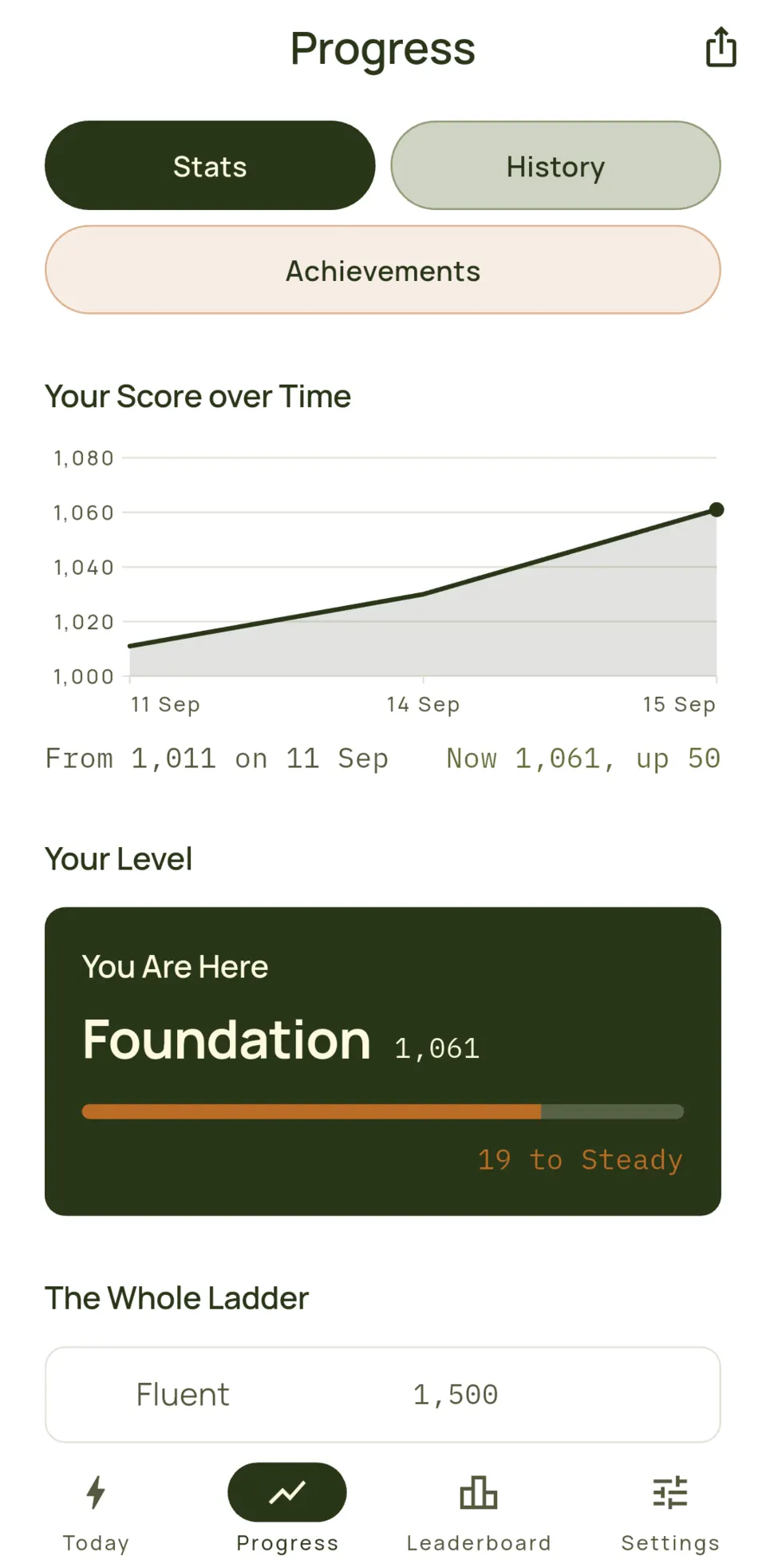
Progress, Stats pane: the score chart rising from 1,011 on 11 Sep to 1,061, and Foundation with 19 to Steady
Session Result: rating change +18, 5 perfect, 0 close, 1 missed, and the miss worked through: 10% of $520 is $52, 30% is three of those: $156, $520 + $156 = $676

Progress, and a session result

Shields for Showing Up, Never for Grinding

Shields reward consistency and firsts, never how much you do in one go. A thousand answers in one day earns no streak shield, and a shield once earned stays earned.

Six Shields

  • A Week RunningPractise 7 days in a row.
  • A Month RunningPractise 30 days in a row.
  • A Hundred DaysPractise 100 days in a row.
  • A Perfect SessionEvery question in a session exactly right.
  • Off the Bottom RungReach Steady, a score of 1,080.
  • Strong All RoundAll five kinds of arithmetic at 1,080 or higher at once.

The streak shields count your longest run ever, so a broken streak does not take them away. Off the Bottom Rung and Strong All Round stay earned even if your score slips back afterwards.

A Streak That Is Fair About Days

Any calendar day on which you answer one question counts, even a wrong one. The streak only breaks when a whole day goes by with nothing answered, so practising on Monday evening keeps it safe until midnight at the end of Tuesday.

Your longest streak never goes down, and your best score is kept beside today's, with the day you reached it.

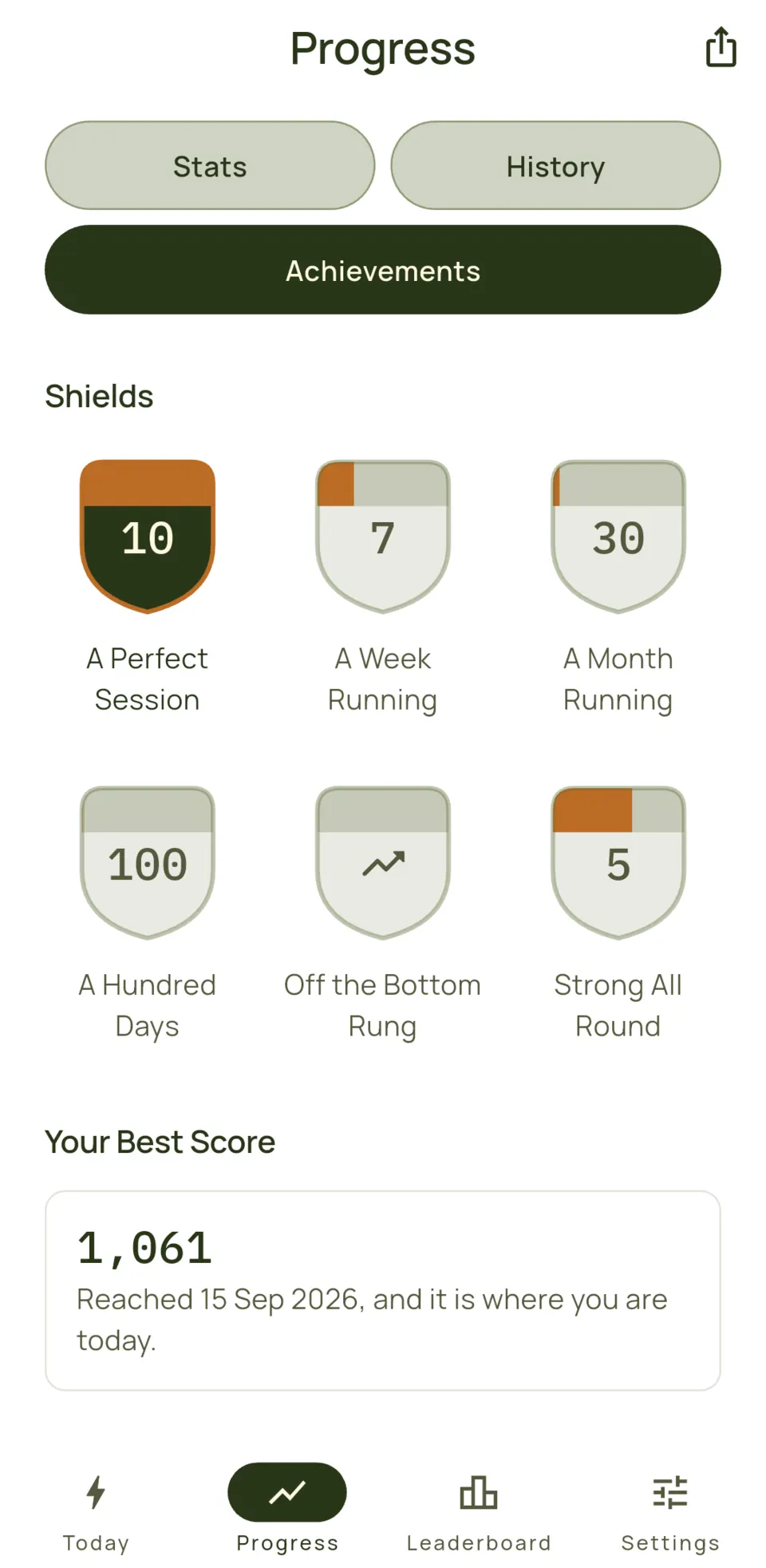
Progress, Achievements pane: six shields with A Perfect Session earned, and a best score of 1,061

Two Boards: Effort This Week, Skill for All Time

Practice never needs an account. Sign in with Google if you want to, and you join a worldwide leaderboard under a nickname you choose.

Ranks effort

This Week

Points earned this week

The same week for everyone: Monday 00:00 to Sunday 23:59 UTC. In India that is 5:30 on Monday morning. The board shows how long is left.

Ranks skill

All Time

Money Fluency Score

Points buy no place here. Only getting harder questions right moves you up.

  • World or regionWorld counts every player. Your region counts only players who chose the same region in Settings.
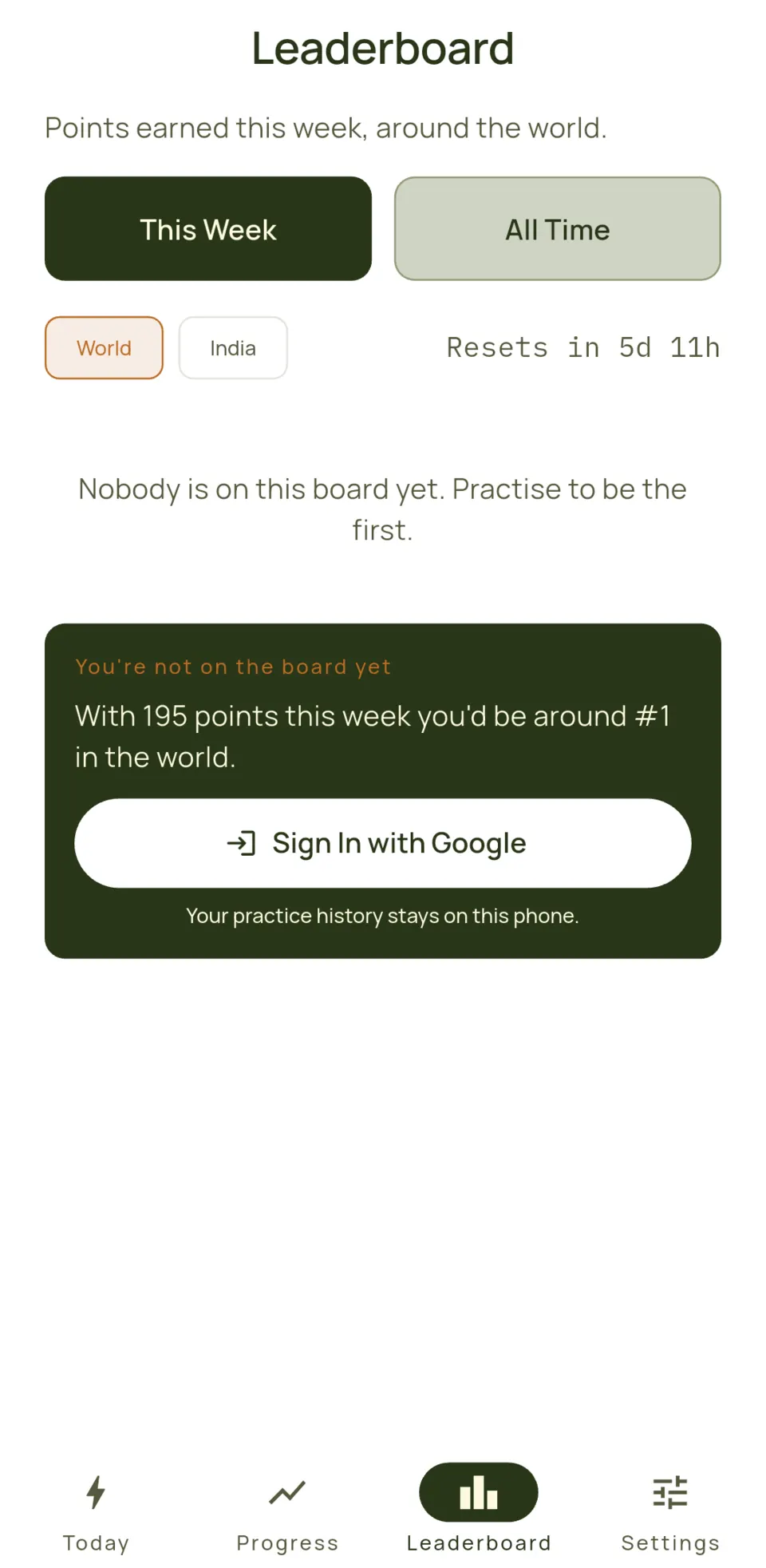
  • Guests can lookBoth boards are open without signing in, with a line saying roughly where you would rank.
  • A nickname, not a name3 to 16 letters, numbers or underscores, changed at most once every 30 days. Other players see your nickname and colour, band, score, streak, shields and when you joined. Never your email, your real name or your answers.
  • Hide any timeTurn off Show Me on the Leaderboard and other players stop seeing you at once.
The Leaderboard as a guest: This Week and All Time, World and India, resets in 5 days, and Sign In with Google

Your Money, in Your Currency

Rupees, dollars, pounds, euros or yen, with the digit grouping you actually use. Choose them independently: dollars with Indian grouping is a combination the app supports on purpose.

Currency
Notation

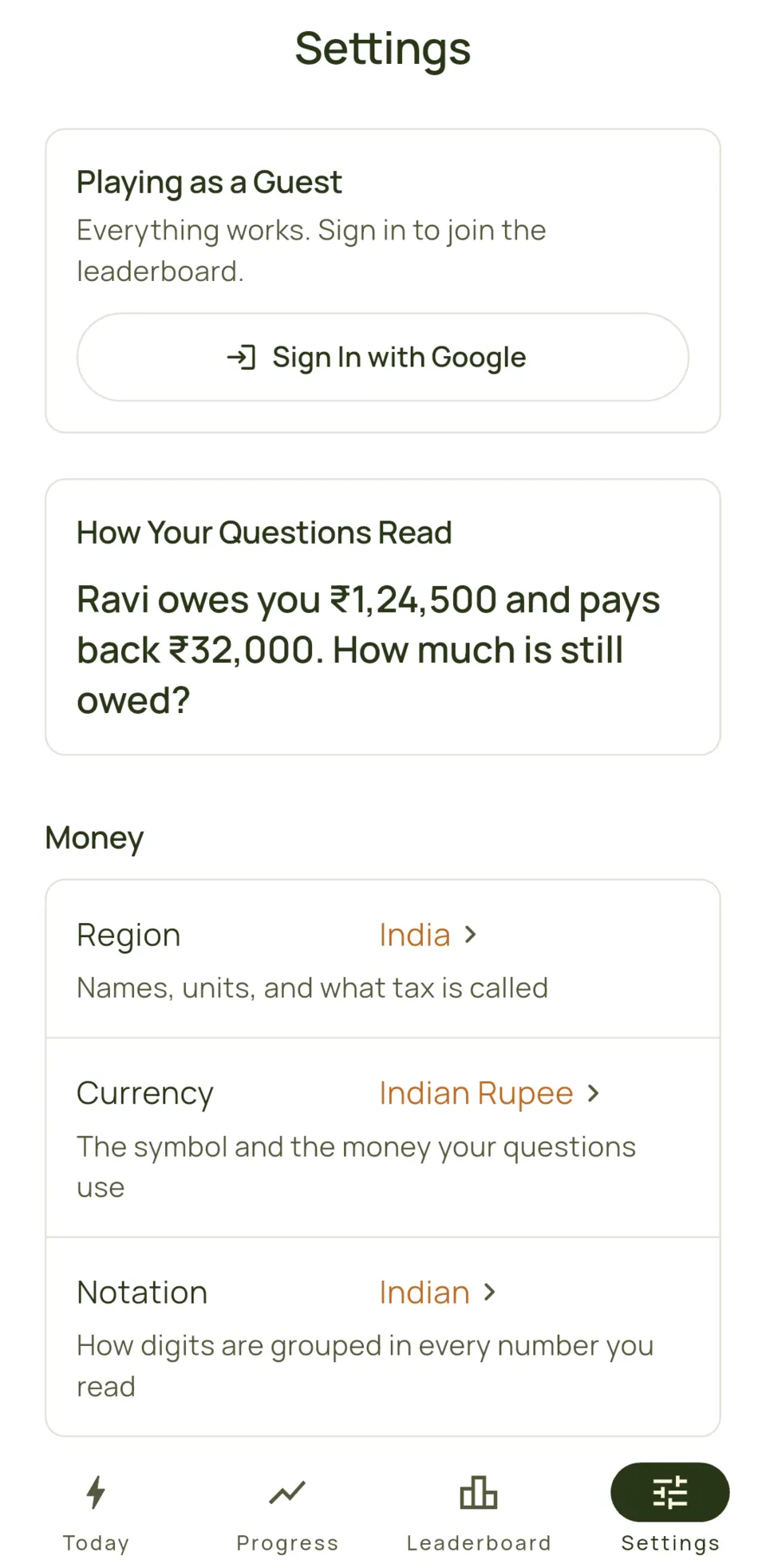
Ravi owes you ₹1,24,500 and pays back ₹32,000. How much is still owed?

Answer ₹92,500, graded Exact Only

Nothing Is Converted

Changing currency does not change how big or how hard the questions are, and it does not change your score or your history. A four digit question is four digits in every currency, which is what keeps scores comparable on one leaderboard.

Fuel follows the currency, so each one uses the price people see at the pump: dollars by the gallon, pounds and euros by the litre in pence or cents, rupees and yen by the litre. Names, weights and what tax is called follow your region, so this preview shows each currency with a name from its home region: Ravi for India, Jack for the United States, Oliver for the United Kingdom, Luca for the eurozone and Yuki for Japan.

Settings: a sample question in rupees with Indian grouping, and the Region, Currency and Notation rows

Your Answers Stay on Your Phone

Your practice history is never uploaded. Practice works offline and needs no account.

  • Nothing is sent as a guestWithout an account, the only thing that ever leaves your phone is a card you choose to share.
  • Only figures if you sign inYour nickname and your figures: score and band, streaks, best score, shields earned, questions solved and this week's points. Never your individual answers.
  • Deleted at onceIn the app, Settings then Delete Account. Without the app, at countera.suryaelite.com/delete-account.
  • No trackersNo advertising, no analytics, no crash reporting services and no trackers.

Questions

Straight answers, most of them the same ones the app gives in its own Questions and Answers.

About Countera

What is Countera?

Countera is an Android app that trains the mental arithmetic people do with money: discounts, unit prices, best value, splitting a bill, and working out what you are still owed. It gives you a real skill rating, the Money Fluency Score, and an optional worldwide leaderboard.

Does it need an account or an internet connection?

No. Practice works offline and needs no account. Signing in with Google is optional and only needed to join the leaderboard.

Can I use a calculator?

Nothing stops you, and nothing checks. It only fools you, though.

The score is there to tell you how your own mental arithmetic is doing, and the questions get harder as it rises, so a score earned with a calculator only brings harder questions you cannot do in your head.

Your Score and Grading

What is the Money Fluency Score?

It is a skill rating, not a points total. It combines five ratings, one each for addition, subtraction, multiplication, division and percentages, and it rises as you get harder questions right.

Why did my score go down?

Only a wrong answer lowers it. On an Exact Only question, anything other than the exact answer is wrong.

Missing a question that is easy for you costs more than missing a hard one. Each answer moves the rating for one kind of arithmetic, and your score combines five of them, so it moves about a fifth as much. Your first 20 answers of each kind move in bigger steps.

Very rarely, an update changes the scoring rules. Your whole history is then scored again under the new rules, which can move your score.

What do "Exact Only" and "Close Counts" mean?

The top of every question card says how it will be graded. Exact Only means only the exact answer counts. Close Counts means near answers earn credit too, and an answer that rounds correctly counts as exact.

Close Counts is used where estimating is the real skill, such as discounts, tax, and how many you can afford. Exact Only is used where a near answer is no use, such as splitting a bill, what is still owed, or picking the best value.

In the Practice Room, small sums are Exact Only and bigger ones are Close Counts, and every percentage drill is Close Counts.

What counts as exact, very close and close?

Near answers only count on Close Counts questions, and how near is judged by the size of the answer.

For an answer of 57,601: 57,601 is exact. Within 100, such as 57,600 or 57,700, is very close. Within 1,000, such as 57,000, 57,500 or 58,000, is close. Anything further, such as 56,000, is wrong.

For an answer of 433: 432 or 434 is very close, and anything from 423 to 443 is close.

Small answers have one extra rule: within 1 of the answer rounded to a whole number is close. If a question works out to 3.96, typing 4 counts as exact, because an answer that rounds correctly is the answer, and 3 or 5 is close.

On the result screen, Very Close and Close are counted together as Close, and Wrong is counted as Missed.

Do I ever need to type decimals?

No. The keypad has digits only, and every answer is a whole number.

When the true answer is not whole, the question is Close Counts and the nearest whole number counts as exact. Questions that demand an exact answer are built so the answer is always whole. After a near answer, the result may still show the exact figure, such as Answer: 3.96.

Does answering fast matter?

For your score, only when you are slow. Each question has an expected time that grows with its size. An exact answer inside that time raises your score in full, however quick you were. A slower exact answer still raises it, just by less. Speed never lowers your score, and it makes no difference to a near answer.

For points, speed matters more. An exact answer earns 12 points when quick, 10 on time, 6 when slow and 1 when very slow.

What do Foundation, Steady, Agile, Sharp and Fluent mean?

They are the five bands your Money Fluency Score climbs through:

  • Foundation: where everyone starts, getting comfortable with numbers.
  • Steady, from 1,080: reliable with everyday calculations.
  • Agile, from 1,210: quicker, with less hesitation.
  • Sharp, from 1,350: real number sense.
  • Fluent, from 1,500: the numbers arrive without being worked out.

The line beside your band on Today, such as 71 to Steady, is how much further your score has to rise to reach the next band. It counts score, not points.

Why can't I reach Fluent by practising one thing?

Because Fluent means fluent in all money maths. Your score combines all five kinds of arithmetic, including any you have never practised, which sit at 1,000. No kind counts for more than 200 above the average of the other four.

So with four kinds at 1,000, the fifth counts as 1,200 at most, whatever its real rating, and your score tops out at 1,040, which is still Foundation. Fluent starts at 1,500.

Your real rating for each kind is on Progress, under Stats.

What are points and how do I earn them?

Points reward effort. Every answer earns at least 1, and a quick exact answer earns the most:

  • Exact: 12 when quick, 10 on time, 6 when slow, 1 when very slow.
  • Very close: 5, or 1 when very slow.
  • Close: 3, or 1 when very slow.
  • Wrong: 1.

Quick means inside 80% of the time expected for that question, slow means up to one and a half times it, and very slow means longer. Your total is on Today and on Progress, under Achievements.

What is the difference between Accuracy and Closeness?

Accuracy is the share of your answers that were exactly right. Closeness is how near your answers land on average: an exact answer counts as 100%, one out by a tenth as 90%, and one out by as much as the answer itself as nothing.

For example, 10 answers with 6 exact and 4 each out by a tenth give an Accuracy of 60% and a Closeness of 96%. Closeness rounds down, so 100% only ever means every answer was exact.

Most money questions are not answered exactly in real life, so a lower Accuracy with a high Closeness is a good place to be. For a wrong Best Value pick, Closeness uses how much more your pick cost for each item.

Practice, Streaks and Shields

Which mode should I pick?

If you are not sure, pick Money Mixed. It is at the top of the Practice screen and draws from everything.

  • Shopping: discounts, the price before a discount, and tax.
  • Margin: buying, selling, and the profit.
  • Rates: unit prices, and how many you can get.
  • Credit: what is owed, paid, and still outstanding.
  • Splitting: bills, and cost per use.
  • Best Value: the cheapest offer per item.

The Practice Room below has plain sums with no money story, one kind of arithmetic at a time or mixed. Every mode feeds the same five ratings, and nothing is locked.

How do Best Value questions work?

You see four offers, each a number of items for a price. Tap the one that costs least for each item. There is no keypad: the tap is your answer, and only the best offer counts.

The biggest pack is not always the best, the best can be in any position, and the offers are never so close that picking is a coin toss. The sum underneath is division, so these count toward your division rating.

Afterwards the best offer is marked with a tick, and a wrong pick with a cross. They have their own mode, Best Value, and also come up in Money Mixed.

How long is a session, and can I change it?

Six questions unless you choose otherwise. On the Practice screen, under How Many, you can pick 6, 12, 25, 50 or 100.

It goes back to 6 each time you open the Practice screen, so one long session does not become your daily session. Keep Going on the result screen repeats the length you just did.

Can I type the answer from right to left?

Yes. In Settings, choose Answer Entry and then Right to Left, or tap the direction button above the keypad during a question. Your choice is remembered.

With Right to Left, each new digit goes in front, the way you work a sum from the units up, so typing 9 then 6 gives 69. The delete key removes the digit you typed last.

What counts as a day for my streak, and when does it break?

Any calendar day, in your phone's own time, on which you answer at least one question. One answer is enough, even a wrong one.

If you practised yesterday but not yet today, your streak still stands for all of today. It only breaks when a whole day goes by with nothing answered. So if you practise on Monday evening, the streak is safe until midnight at the end of Tuesday.

The streak card shows the day your streak started, your longest streak, and this week. Your longest streak never goes down.

What are shields, and how do I earn each one?

Shields are on Progress, under Achievements. They reward consistency and firsts, never how much you do in one go.

  • A Week Running: practise 7 days in a row.
  • A Month Running: practise 30 days in a row.
  • A Hundred Days: practise 100 days in a row.
  • A Perfect Session: get every question in a session exactly right.
  • Off the Bottom Rung: reach Steady, a Money Fluency Score of 1,080.
  • Strong All Round: get all five kinds of arithmetic to 1,080 or higher at the same time.

The streak shields count your longest run ever, so a broken streak does not take them away. Off the Bottom Rung and Strong All Round are earned the moment you reach them, and stay earned even if your score slips back afterwards.

Money, Leaderboard and Your Data

Which currencies does Countera support?

Rupees, dollars, pounds, euros or yen, with the digit grouping and units you actually use. Currency and region can be chosen independently.

How is This Week ranked, and when does it reset?

This Week ranks points earned this week, so effort decides it. All Time ranks the Money Fluency Score, so skill decides it.

The week is the same for everyone: Monday 00:00 to Sunday 23:59 UTC. In India that is 5:30 on Monday morning. The board shows how long is left.

Why is my rank different in World and in my region?

World counts every player; your region counts only players who chose the same region in Settings. Changing your region moves you to that region's board.

What do other players see about me?

Only your nickname and colour, your band, your score, your streak, your shields and when you joined. Never your email, your real name or your answers.

What leaves the phone when I sign in?

Only your nickname and your figures: your score and band, streaks, best score, shields earned, questions solved and this week's points. Your practice history and individual answers are never uploaded.

What happens if I uninstall the app or change phones?

Your practice history lives on your phone, so uninstalling removes it unless your phone backs it up.

Android backs up app data to your own Google Drive, so restoring a backup on a new phone usually brings your history with it. Countera cannot check that, so do not rely on it. Your leaderboard account is kept on the server either way: sign in on the new phone to carry on.

How do I delete my account?

In the app: Settings, then Delete Account. Without the app: countera.suryaelite.com/delete-account. Either way, deletion is immediate.

Countera Is on Google Play

Countera is free on Android and the listing is live. If you would rather try before you install, the question at the top of this page is a fair taste of what practice feels like.